
Constellation Software & Topicus
Inside the world’s best capital allocation machine and the sibling built to replicate it.

Both CSU and Topicus are down roughly 50% from their 2025 highs. The selloff was triggered by three concerns: that AI lets clients build their own software, that AI-native competitors will undercut on price, and that Mark Leonard stepping back leaves the company rudderless. The bigger question is valuation — these have always been market darlings trading at 30-50x cash flows. After this drawdown they’re at ~22x. Still not cheap, but for the first time in a decade the math is starting to make sense. Below, I’ll walk through each concern and the valuation in detail — and share whether I think either stock is offering an attractive entry right now.
Vertical Market Software
Vertical Market Software (VMS) is software built for one specific industry, mission-critical inside that niche, and largely useless outside of it. The verticals are deliberately boring — boring is the whole point. A cemetery doesn’t want cutting-edge features; it wants a system that maps every gravesite correctly and never goes down. A court doesn’t want innovation in its records system; it wants chain-of-custody integrity in every audit.
Examples of the kind of niche businesses CSU and Topicus own:
Cemetery management — plot mapping, burial scheduling, genealogy records
Court records administration — evidence handling, chain-of-custody, case docketing
Public transit scheduling — bus and subway route, shift and fleet management
Utility billing and grid management for water, gas and electricity providers
Hospital information systems and electronic health records
Public-sector ERP for municipalities, courts and central government
Dental practice management, fishing license platforms, oil-drilling simulation tools
The economic logic is well established. The software is mission-critical, so the customer can’t risk switching. Switching costs are enormous — data migration, workflow rewiring, retraining, regulatory revalidation. Crucially, software is typically less than 1% of the customer’s revenue, so there’s no real budget pressure to switch even when a cheaper alternative exists. Churn runs below 5% annually. Recurring maintenance and support revenue is 70-80% of the top line.
The strategy is straightforward: buy small VMS businesses at 5-10x EBITDA, leave existing management in place, redirect the free cash flow into more of the same. Hold forever. Don’t try to integrate them — every vertical is too different. Push capital-allocation decisions down to the operating groups, because no one at headquarters can possibly understand 40+ verticals at the depth required to underwrite acquisitions.
Constellation Software (CSU)
Mark Leonard founded Constellation Software in 1995 in Toronto. Before getting into venture capital he had worked as a dog handler, a bouncer and a gravedigger, which is itself a useful filter — he had to learn investing from the ground up rather than inherit a thesis from business school. The thing he disliked most about venture capital was the short-termism. He wanted to own businesses forever and watch them compound. VMS turned out to be the asset class that made that strategy work.
CSU’s first acquisition was Trapeze Software in 1995. The company went public in 2006. It has compounded at roughly 20% annually for two decades. Today CSU owns more than 1,000 subsidiaries through seven operating groups: Volaris, Harris, Vela, Jonas, Perseus, Topicus and Andromeda. It does around 100 acquisitions per year, average ticket size around $5M, and the operating groups — not Leonard or HQ — make almost all the decisions.
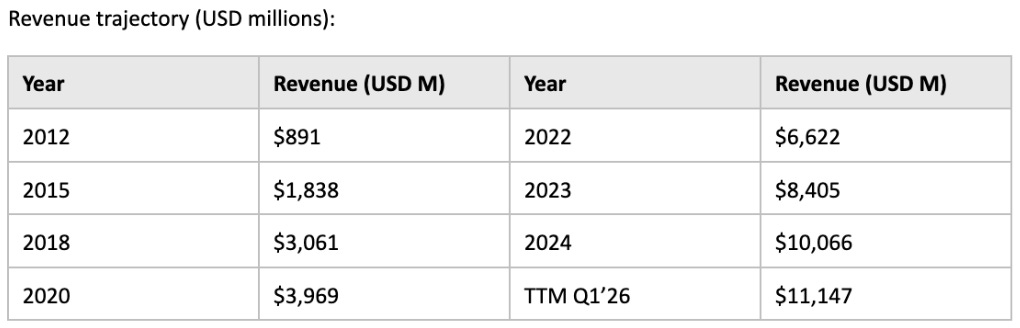
Roughly 75% of revenue is maintenance and recurring services. EBITDA margins are in the high 20s. Customer retention is approximately 98%. After CSU’s late-2025 AI-focused call, Mark Leonard stepped down as CEO for health reasons and Mark Miller — who has been at CSU since the 1995 founding, having sold his original company as CSU’s first acquisition — took over.
Topicus (TOI)
Topicus is the European VMS arm of the Constellation family. The arc is short. Robin van Poelje founded Total Specific Solutions (TSS) in the Netherlands in 2010. Constellation Software Inc. (CSI) acquired TSS in January 2014, then acquired Topicus B.V. from the Dijkhuizen family in 2020. In February 2021, CSI combined TSS and Topicus B.V. and spun out Topicus.com Inc. on the TSX Venture Exchange.
What makes Topicus different from Constellation:
Geographic focus. TOI hunts only in Europe — Benelux, DACH, the Nordics, Central and Eastern Europe, the UK and Ireland. CSU is global.
Scale. TOI is roughly a quarter of CSU’s size. Smaller deals are still highly impactful, and the law of large numbers won’t bite for years.
Fragmentation advantage. Europe has more VMS targets than North America — an estimated 30,000-40,000 private VMS businesses across the region. Language, regulatory and cultural fragmentation makes cross-border consolidation hard, which is exactly why TSS’s 26-country decentralized model is so well-suited to the market.
Founder preference. European founders are typically reluctant to sell to private equity. Topicus’s permanent-home positioning resonates with them in a way that a 5-7 year PE fund cannot.
What Topicus owns today:
180+ operating subsidiaries
40+ industry verticals
16 countries
More than 10,000 employees
FY2025 revenue of €1,552M (71% recurring)
Three operating groups: TSS Public (Han Knooren, public-sector Benelux), TSS Blue (Ramon Zanders, private-sector verticals), and Topicus (Daan Dijkhuizen, original Dutch financial-services and healthcare group)
CSI owns approximately 30% of Topicus’s economic interest and 50.1% of voting power via a Super Voting Share. So CSI is the controlling shareholder and remains the cultural transmission mechanism from the parent, but most of the economic upside accrues to other shareholders.
Three Bear Cases
Both CSU and Topicus are down roughly 50% from their 2025 highs. CSU went from over C$5,000 to around C$2,450, with the peak multiple north of 50x FCFA2S and the current multiple around 20x. TOI fell from C$199 to C$93.93, peak multiple over 50x, current multiple around 23x. Three concerns are doing the work.
A) Mark Leonard’s exit
Leonard stepped down as CSU’s CEO in late 2025 for health reasons. He did not stand for re-election to the Topicus board in May 2023 either.
I agree Leonard was a great CEO and an irreplaceable asset. But the culture he built is the actual moat, and the culture is durable. He intentionally designed CSU to be decentralized; he was not in the deal flow for most acquisitions anyway. The compensation system requires 75% of after-tax bonuses to be used to buy stock on the open market and held for at least four years. Management is shareholder-aligned, frugal, allergic to dilution. The 20% IRR hurdle is institutionalized — Leonard himself wrote about why he wouldn’t lower it broadly across the organization (“the magnetism effect”).
Mark Miller, the new CEO, has been at CSU since 1995. He sold his original company as CSU’s first acquisition. He is not going to change the model. Robin van Poelje at Topicus has been running this exact playbook for 16 years. The cultural inheritance is intact at both companies.
This is the kind of culture that survives the founder. I believe both companies can manage without Leonard at the wheel.
B) AI risk #1 — clients build their own software
The argument: LLMs make custom software cheap enough that customers can replace their VMS provider with an in-house build. Why pay Constellation when you can vibe-code it?
My Take: